Showing posts with label design. Show all posts

What Does a Great Distributed Digital Museum Experience Look Like?

Museum technology nerds: this post is for you.

I've been thinking recently about distributed content experiences--ways for people to interact with museum content (art, history, science, etc.) as they make their way through the world outside the museum. There are a zillion apps for making your own tours, podcasts, maps, or QR code-infested games... but none of them are great.

Distributed mobile content experiences seem to suffer from two basic problems:
  1. Underwhelming entry points. It's extremely hard to get people to download a new app. Where and when does an institution ask you to do so? At the museum? At the historic site? While walking down the street? The impulse to download an app is driven by curiosity or an urgent perceived need. While museums may cultivate curiosity, they rarely offer sufficiently clear, urgent use cases to encourage you to go through the drudgery of downloading an app.  
  2. Unlikely reentry points. Once you download an app, are you really going to remember to (re)open it to find an interesting historical fact tagged to your geolocation? Are you going to use it to scan for public art near you? Most of these apps seem so niche, so useless for anything other than accessing semi-interesting content in a clunky interface, that they end up languishing in the Siberian outback of your phone.
In contrast, successful distributed projects seem to have one of two characteristics:
  1. Compelling and/or versatile mobile experience. What do we use our phones for most? Communicating, playing, exploring. Quality content experiences tend to piggyback on massive social media platforms apps that are already well-used (i.e. facebook) or create very compelling whole worlds unto themselves (i.e. Pokemon Go). 
  2. Prominent real world presence. One of the simplest, effective distributed projects I've seen recently is Walk [Your City]. It's a system for creating signs, zip-tied to existing traffic/lightpoles, that direct people to points of interest, special experiences, and surprising encounters. Some cities use them for straightforward wayfinding, but in many towns, the signs have a whimsical or poetic nature. It's amazing how much impact simple signs can have. I'd choose repeated physical presence over a fancy digital interface any day.
Thinking about these two characteristics, here are some highly speculative ideas and questions:
  • What is the most effective way to have lots of physical presence in the built environment? Working with cities and public property involves a lot of regulation (though if you can push through the red tape, a lot of potential impact). It's often easier to make deals with private property owners than to lobby the government for use of public space/sidewalks/streets. Projects like Little Free Library and the Peace Pole Project work this way; individuals choose to build them on their own land. How can we activate movements for people to participate in producing and sharing content on the land they already control?
  • What's the cheapest advertising money can buy? I generally assume nonprofits can't afford to compete in the advertising world, but there's so much advertising in our visual landscape, some of it in very odd (and affordable) forms. Could you give out free coasters at bars? Make beautiful bike racks? Provide your local coffee shop with thousands of sleeves for paper cups? Is there a distributed layer to life (in the form of advertising) that is hackable for good?
  • How can we creatively hack into mobile apps that lots of people already use? Of course you can create content for podcasts, twitter, instagram, etc. But what about apps where you don't have to build a whole media presence? What about creating geo-fenced Snapchat filters connecting people to art nearby, or making Tindr profiles for historical figures in the area? Are there other ways to piggyback on popular apps for content experiences?
  • Who's going to build the killer app for distributed learning experiences? Part of me feels like learning is just so low on people's priority lists that distributed museum experiences will always be niche... but then I think of the huge success of online learning platforms like Khan's Academy. I wonder if we just need one (or a few) powerhouse app to take the lead on facilitating quality distributed learning/augmented reality experiences. I think it's possible an institution could do this... but only if it was more focused on building an industry-wide solution than building something custom for their own museum or historic site.
I know that there are very smart people working on these problems. Who's tackling them? What are some of the most interesting approaches underway?

If you are reading this via email and would like to share a comment or question, you can join the conversation here. 

And a note to readers in the Boston area: I'll be participating in a MuseumHive real world / Google hangout on these topics (and others) on October 26. Register today.


Temple Contemporary and the Puzzle of Sharing Powerful Processes


The first thing I noticed about Temple Contemporary were the chairs. Desk chairs and theater seats, sleek modsters and dilapidated stuffed things, a motley crew lined up on hooks around the room. They were charming, but puzzling. Looking closer, I saw that each seat had its own handwritten label, telling the story of the Philadelphia cultural institution from which it originated. The chairs were cast-off art, reclaimed as art, available for people to take off the hooks and use. They were there for artist talks. They were there for project brainstorming. They were there for chair races.

What kind of an art institution is this? That's what I found myself wondering again and again in the too-short hour I spent with the director of Temple Contemporary, Rob Blackson. Temple Contemporary makes strange objects and gorgeous documentation. It encourages process-driven performances and art projects. It is unfinished, unassuming, and whimsical, and at the same time, deadly serious. It takes the kind of risks that a university art gallery should take. It opens up new conversations about the work of art in our communities.

Temple Contemporary�s mission is to creatively re-imagine the social function of art through questions of local relevance and international significance. They live their mission, working in questions and projects rather than exhibitions and programs. Every other year, they convene TUPAC, a group of 35 outside advisors, including teens, college students, Temple University professors, artists, philanthropists, and community leaders. TUPAC advisors come together for one meeting, each bringing a question of local relevance and international significance--a question they don't know the answer to. The advisors share their questions, vote on the ones that they think have the most power, and set the direction of Temple Contemporary.

For example, right now, Temple Contemporary's offices are packed floor to ceiling with broken musical instruments from classrooms across the city of Philadelphia. One of TUPAC's current questions is about the state of art education. In Philadelphia, the budget for arts education has been slashed to pieces. The cuts were so deep that school music rooms are full of unplayable instruments. There's no money to fix them. And so, sparked by TUPAC's big question, Temple Contemporary decided to collect these silenced instruments - 1,500 in all - and commission a Symphony for a Broken Orchestra by a famous composer, David Lang. After the symphony premieres in 2017, Temple Contemporary will have all the instruments restored and will return them to their schools, new repair kits tucked inside the cases.

I left Temple Contemporary energized and inspired by their work. The work that Temple Contemporary is doing with their community is radical and impressive. Temple Contemporary is truly community-led. There is no formula. The community drives the question. The question drives the work. And the work takes the form or forms to which it is best suited. This makes Temple Contemporary excel at responsive, relevant projects. But it also makes their "front-end" experience incoherent. As a visitor, I'm not sure what I left with. My positive experience was 95% rooted in the tour that Rob Blackson gave me. Without him as my guide, all I had was fragments. A bunch of chairs hanging on the wall. Some students folding clothes. Empty pegboards. Half a car attached to the ceiling. Artsy journals. I saw slices of something interesting, but I had no idea how to piece them together.

I would never have learned about the Symphony for a Broken Orchestra if I hadn't been invited into the back office. I would never have known that TUPAC exists, who they are, or what they do. I wouldn't have drunk from the cup made from Pennsylvania oil field shale or read the book about the funeral they held for a row house. I would have walked in, puzzled at the white box's mysteries, and walked out.

This problem isn't unique to Temple Contemporary. It's a challenge in all process-driven work. Often the most powerful community work lives behind the scenes, in the brainstorming and prototyping and trying things out. The same is true of much artwork--the juice is often in the work's development, which dies a little bit when the work is "done." But that juice is fickle. It is powerful when you can experience it directly. It loses its flavor--or is completely imperceptible--when people don't understand what they are drinking.

How do we resolve this? The standard answer is to let the process stay behind the curtain and the product live onstage. Give people the exhibition but not the debates about content development. Give people the symphony but not the stacks of patient, injured cellos. This approach is straightforward. Leave the process to the collaborators and give the product to the audience. But there are two big problems with this approach:
  1. It's easy to get caught in the hamster wheel of delivering products to audiences. You start systematizing to deliver a program every week, an exhibition every quarter. You promise your audience quality and you hone your process to deliver it. You don't have time to convene the community. You don't have flexibility to imagine whether their questions are better answered with a symphony or a storybook. You don't have space to take the instruments. You can't open yourself fully to the possibilities. 
  2. It denies audiences the powerful opportunity to tap into the process. In most of these kinds of projects, the number of collaborators is finite. The collaborators themselves are often hand-selected or nominated. Visitors can't walk off the street with their own big question and join the scrum. While that's sensible, it's also limiting. How could Temple Contemporary (or any institution) invite each person who walks in the door into the biggest, meatiest work currently underway?
How can we invite people into the processes that drive our most powerful work?

I don't have the answers. I'm curious if you do--and what big questions this sparks for you.

If you are reading this via email and would like to share a comment or question, you can join the conversation here. 

What Does Audience-Centered Look Like? It Looks like Glasgow Museums.

KelvingroveWhen we say we want our museum to be "audience-centered," what do we mean?

Over the past decade, I've seen two distinct versions of this term:
  1. the user-centered museum, in which visitors are active participants, invited to contribute to and co-create the experience
  2. the customer-centered museum, in which visitors are valued guests, invited to enjoy personalized experiences that cater to their specific needs and interests
It will be no surprise to hear that I fundamentally align with the user-centered model. However, I have enormous respect for the customer-centered model when it is executed in ways that truly invite visitors in on their own terms and deliver satisfying experiences. My career first got moving at a brilliant example of the customer-centered museum: the International Spy Museum. Many of my favorite museums, libraries, and zoos are customer-centered places. They care about visitor comfort. They deliver learning experiences at many levels, engaging many senses. They are responsive to visitors' needs and interests, and they are willing to tailor their offerings to better satisfy those visitors.

To be clear: I'm not a fan of all aspects of customer-centered museums. At their worst, instead of human-centered, they become commerce-centered institutions, overly focused on the shop, the restaurant, the spectacle, and the highest ticket price the market can bear. But at their best, they focus on the humans walking in the door, providing them with value on their own terms. One hundred years ago, John Cotton Dana, founder of the Newark Museum and godfather of modern museums, famously said: �A great department store, easily reached, open at all hours, is more like a good museum of art than any of the museums we have yet established." I believe that Dana's department store museum is best exemplified in the customer-centered museum. The customer may not always be right, but she deserves to have an experience that brings her comfort, satisfaction, and joy.

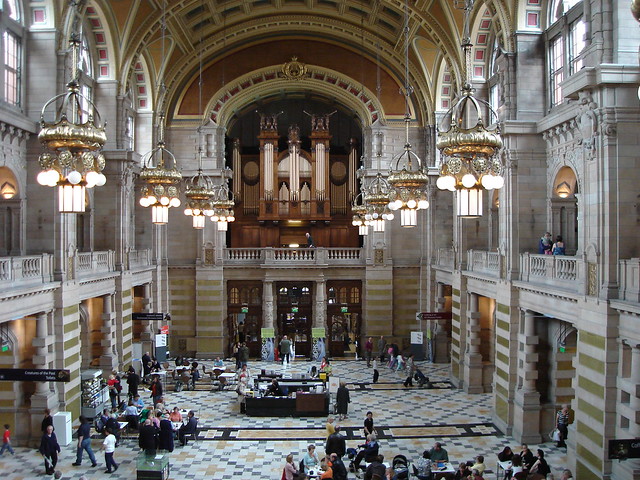
I felt that comfort, satisfaction, and joy on a recent visit to two museums in Glasgow: Kelvingrove Art Gallery and Museum and Riverside Museum. Kelvingrove is an encyclopedic museum, the kind where pachyderms, mummies, and Impressionists rub shoulders. Riverside is a museum of transportation, packed with trains, bicycles, and motorcars. Both of these museums delivered incredible experiences for me and my husband. These museums were terrific examples of customer-centered institutions because:
  • They engaged our curiosity. The objects were interesting, the stories surprising. At Kelvingrove, a display of knights, swords, and shields (one I'd usually skip) was peppered with animals whose skin and scales formed body armor, drawing me to look closer and better understand the connections between how living creatures defend ourselves. At Riverside, a torn-up Ford Escort explained how car thieves cut up and weld together stolen chassis, displaying the ingenuity and dangerous implications of chop shops. These displays were memorable. They taught us something new. They prompted dialogue and a desire to keep looking.
  • They catered to different audiences. Kelvingrove in particular was impressive for embracing an eclectic, "we all belong here" approach to gallery design and display. You could come for the Scottish first peoples or the World War II art or the dinosaurs or the collection of funny shoes. All were given value. I never felt like I stumbled into the gallery where no one else dares to tread (as I often feel when I enter the dioramas in many natural history museums, or the period rooms of art institutions). And they did a good job calling out and tailoring areas for families and young ones without making those spaces feel segregated from the overall experience.
  • They offered immersive, powerful environments. Both institutions made good use of their very different spaces. Kelvingrove is in a hundred-year-old palace of galleries around a central court in a park, whereas Riverside is a 2011 Zaha Hadid open-plan warehouse on a riverfront with a dramatic contemporary exterior. In Kelvingrove, we strolled easily from gallery to gallery, through open thresholds that encouraged exploration while maintaining distinct character from room to room. At Riverside, we wandered from display to display around the open floor, again, feeling comfortable, accommodated, and stimulated by bicycles racing around a velodrome overhead and 1920s buses squatting on the concrete. The objects in both museums were varied, and the display techniques incorporated movement, varied sight lines, juxtaposition, and humor to keep us intrigued and engaged.
  • They offered genuinely interesting learning experiences. In each museum, we saw thematic displays and labels that surprised and engrossed us. At Kelvingrove, we were particularly taken by Looking at Art, a gallery that invited us to check out a painting in various stages of restoration, to look at the backs of paintings and the things that were crossed out, and to learn more about the stories and influences behind specific artworks. I'd seen each of these kinds of elements in other museums, but never in such a clear way that respected visitors' intelligence and provided us with genuinely new information. At Riverside, I was impressed by the consistent integration of community voices in label text, and the very human take on a genre (transportation) that is often presented strictly in terms of technology and provenance. There were displays about the terror of motorcycle accidents, the freedoms public transportation affords, and the ways vehicles can enable people to enjoy places that are otherwise inaccessible to them. I'd heard before about Riverside's development, which involved many community focus groups, workshops, and talkbacks. That work showed in the human voices and stories throughout the museum. Of course, these are tools of user-centered institutions! It was lovely to see their integration into such strong customer-centered experiences.
  • They acknowledged our desire for comfort and variation. One of the best bits of our trip to Kelvingrove was taking a break to enjoy the free pipe organ concert in the central court. We took a break from the galleries, had a drink, and listened to the music as we chatted about our experience. This kind of accommodation in museums is nothing new, but it was made special because of how it fit into the flow of the building. We didn't have to go outside or to some segregated area to have coffee. It was there, in the heart of the museum, where we could gaze up at the galleries we'd been to and the ones we'd skipped. It wasn't a destination or a set-aside place of respite; comfort and social activity were at the very center of the building.
It's interesting to note that Kelvingrove and Riverside, like all the Glasgow Museums, are part of a public charity called Glasgow Life. Glasgow Life oversees libraries, museums, arts events, music venues, sporting events and fields, and community services on behalf of the City of Glasgow. Their vision statement is "to inspire Glasgow's citizens and visitors to lead richer and more active lives through culture and sport." In pursuing this vision statement and this diverse work, Glasgow Life recognizes serving a community means being both user- and customer-centered. Sometimes we are customers and sometimes we are users. Sometimes we are watching the match and sometimes we are kicking the ball. Sometimes we are enjoying the music and sometimes we are playing it.

Glasgow Museums include other institutions--notably, Glasgow Open Museum--that are far more user-centered. (Glasgow Open Museum, which co-creates exhibitions with and in community spaces across the city, served as a case study in The Participatory Museum.) But as a tourist on a summer day, I didn't seek out that user-centered institution. Instead, I walked into Kelvingrove and Riverside--two fine department stores of humanity--and walked out a satisfied customer.

Not A Great Deal Seems To Have Happened In the Last Few Years. Really Pretty Hopeless.

For some reason Google found this for me today � and note the article date. Dr Mukesh Haikerwal Resigns from NEHTA By Petrina Smith Friday, ...