I've been traveling a lot recently, exploring the ideas behind The Art of Relevance with colleagues around the US. Here are two artifacts of my travels... and an opportunity to join in on a virtual/real life meetup this Wednesday.
VIDEO - THE ART OF RELEVANCE
Want to join the conversation about The Art of Relevance but can't make it to a book event? The Minnesota Historical Society made a video of my recent talk there. The video is well-produced, including subtitles and the Q&A. I talk for the first 30 minutes, and then we're doing Q&A in the second half. Check it out.
AUDIO - PRATFALLS PODCAST
Immediately after leaving the Minnesota Historical Society, I sat down with Levi Weinhagen as a guest on his Pratfalls podcast. Levi is an excellent interviewer, and he got me talking about lots of things I don't usually talk about: living off the grid, finding my path, learning from my parents, being a mom and museum director, dreaming of being a ninja warrior. It's an hour interview, and if you enjoy it, I strongly recommend checking out Levi's other episodes interviewing creative people about how they approach their work.
HANGOUT - MUSEUMHIVE
This Wednesday, I'm participating in an experimental Museumhive event. It combines a real life meetup (in Boston) with a virtual Google hangout. I'll be joining in via hangout to talk about distributed museums with Brad Larson, Ed Rodley, Paul Orselli, and lots of Boston area colleagues. You can participate virtually, or if you are in the Boston area, register (for free) to be there in person.
Enjoy the media, get connected, go outside!

What Does a Great Distributed Digital Museum Experience Look Like?

I've been thinking recently about distributed content experiences--ways for people to interact with museum content (art, history, science, etc.) as they make their way through the world outside the museum. There are a zillion apps for making your own tours, podcasts, maps, or QR code-infested games... but none of them are great.
Distributed mobile content experiences seem to suffer from two basic problems:
- Underwhelming entry points. It's extremely hard to get people to download a new app. Where and when does an institution ask you to do so? At the museum? At the historic site? While walking down the street? The impulse to download an app is driven by curiosity or an urgent perceived need. While museums may cultivate curiosity, they rarely offer sufficiently clear, urgent use cases to encourage you to go through the drudgery of downloading an app.
- Unlikely reentry points. Once you download an app, are you really going to remember to (re)open it to find an interesting historical fact tagged to your geolocation? Are you going to use it to scan for public art near you? Most of these apps seem so niche, so useless for anything other than accessing semi-interesting content in a clunky interface, that they end up languishing in the Siberian outback of your phone.
In contrast, successful distributed projects seem to have one of two characteristics:
- Compelling and/or versatile mobile experience. What do we use our phones for most? Communicating, playing, exploring. Quality content experiences tend to piggyback on massive social media platforms apps that are already well-used (i.e. facebook) or create very compelling whole worlds unto themselves (i.e. Pokemon Go).
- Prominent real world presence. One of the simplest, effective distributed projects I've seen recently is Walk [Your City]. It's a system for creating signs, zip-tied to existing traffic/lightpoles, that direct people to points of interest, special experiences, and surprising encounters. Some cities use them for straightforward wayfinding, but in many towns, the signs have a whimsical or poetic nature. It's amazing how much impact simple signs can have. I'd choose repeated physical presence over a fancy digital interface any day.
Thinking about these two characteristics, here are some highly speculative ideas and questions:
- What is the most effective way to have lots of physical presence in the built environment? Working with cities and public property involves a lot of regulation (though if you can push through the red tape, a lot of potential impact). It's often easier to make deals with private property owners than to lobby the government for use of public space/sidewalks/streets. Projects like Little Free Library and the Peace Pole Project work this way; individuals choose to build them on their own land. How can we activate movements for people to participate in producing and sharing content on the land they already control?
- What's the cheapest advertising money can buy? I generally assume nonprofits can't afford to compete in the advertising world, but there's so much advertising in our visual landscape, some of it in very odd (and affordable) forms. Could you give out free coasters at bars? Make beautiful bike racks? Provide your local coffee shop with thousands of sleeves for paper cups? Is there a distributed layer to life (in the form of advertising) that is hackable for good?
- How can we creatively hack into mobile apps that lots of people already use? Of course you can create content for podcasts, twitter, instagram, etc. But what about apps where you don't have to build a whole media presence? What about creating geo-fenced Snapchat filters connecting people to art nearby, or making Tindr profiles for historical figures in the area? Are there other ways to piggyback on popular apps for content experiences?
- Who's going to build the killer app for distributed learning experiences? Part of me feels like learning is just so low on people's priority lists that distributed museum experiences will always be niche... but then I think of the huge success of online learning platforms like Khan's Academy. I wonder if we just need one (or a few) powerhouse app to take the lead on facilitating quality distributed learning/augmented reality experiences. I think it's possible an institution could do this... but only if it was more focused on building an industry-wide solution than building something custom for their own museum or historic site.
I know that there are very smart people working on these problems. Who's tackling them? What are some of the most interesting approaches underway?
If you are reading this via email and would like to share a comment or question, you can join the conversation here.
And a note to readers in the Boston area: I'll be participating in a MuseumHive real world / Google hangout on these topics (and others) on October 26. Register today.
Temple Contemporary and the Puzzle of Sharing Powerful Processes
 |
What kind of an art institution is this? That's what I found myself wondering again and again in the too-short hour I spent with the director of Temple Contemporary, Rob Blackson. Temple Contemporary makes strange objects and gorgeous documentation. It encourages process-driven performances and art projects. It is unfinished, unassuming, and whimsical, and at the same time, deadly serious. It takes the kind of risks that a university art gallery should take. It opens up new conversations about the work of art in our communities.
Temple Contemporary�s mission is to creatively re-imagine the social function of art through questions of local relevance and international significance. They live their mission, working in questions and projects rather than exhibitions and programs. Every other year, they convene TUPAC, a group of 35 outside advisors, including teens, college students, Temple University professors, artists, philanthropists, and community leaders. TUPAC advisors come together for one meeting, each bringing a question of local relevance and international significance--a question they don't know the answer to. The advisors share their questions, vote on the ones that they think have the most power, and set the direction of Temple Contemporary.

I left Temple Contemporary energized and inspired by their work. The work that Temple Contemporary is doing with their community is radical and impressive. Temple Contemporary is truly community-led. There is no formula. The community drives the question. The question drives the work. And the work takes the form or forms to which it is best suited. This makes Temple Contemporary excel at responsive, relevant projects. But it also makes their "front-end" experience incoherent. As a visitor, I'm not sure what I left with. My positive experience was 95% rooted in the tour that Rob Blackson gave me. Without him as my guide, all I had was fragments. A bunch of chairs hanging on the wall. Some students folding clothes. Empty pegboards. Half a car attached to the ceiling. Artsy journals. I saw slices of something interesting, but I had no idea how to piece them together.
I would never have learned about the Symphony for a Broken Orchestra if I hadn't been invited into the back office. I would never have known that TUPAC exists, who they are, or what they do. I wouldn't have drunk from the cup made from Pennsylvania oil field shale or read the book about the funeral they held for a row house. I would have walked in, puzzled at the white box's mysteries, and walked out.
This problem isn't unique to Temple Contemporary. It's a challenge in all process-driven work. Often the most powerful community work lives behind the scenes, in the brainstorming and prototyping and trying things out. The same is true of much artwork--the juice is often in the work's development, which dies a little bit when the work is "done." But that juice is fickle. It is powerful when you can experience it directly. It loses its flavor--or is completely imperceptible--when people don't understand what they are drinking.
How do we resolve this? The standard answer is to let the process stay behind the curtain and the product live onstage. Give people the exhibition but not the debates about content development. Give people the symphony but not the stacks of patient, injured cellos. This approach is straightforward. Leave the process to the collaborators and give the product to the audience. But there are two big problems with this approach:
- It's easy to get caught in the hamster wheel of delivering products to audiences. You start systematizing to deliver a program every week, an exhibition every quarter. You promise your audience quality and you hone your process to deliver it. You don't have time to convene the community. You don't have flexibility to imagine whether their questions are better answered with a symphony or a storybook. You don't have space to take the instruments. You can't open yourself fully to the possibilities.
- It denies audiences the powerful opportunity to tap into the process. In most of these kinds of projects, the number of collaborators is finite. The collaborators themselves are often hand-selected or nominated. Visitors can't walk off the street with their own big question and join the scrum. While that's sensible, it's also limiting. How could Temple Contemporary (or any institution) invite each person who walks in the door into the biggest, meatiest work currently underway?
I don't have the answers. I'm curious if you do--and what big questions this sparks for you.
If you are reading this via email and would like to share a comment or question, you can join the conversation here.
Coming to Your Town, The Art of Relevance in Hand
 |
| Co-pilot sadly not attending these events. |
Maybe you've been feeling this way about coming to an event related to The Art of Relevance. You'd like to participate, but it would have taken too much effort to attend the summer book launch events in Edinburgh and Santa Cruz. Fortunately, I'm hitting the road this fall, and I hope to be able to discuss this book with you at a time and place that hits your sweet spot in the effort/meaning calculus.
All the 2016 book events are here (and frequently updated). But here's a quick list of the conferences, public events and workshops where I'll be appearing in the next few months. I'd love to meet you there.
PUBLIC EVENTS TO WHICH ALL ARE INVITED
- September 28, 2016: St. Paul, MN at the Minnesota History Center, 8-10am - Free! Register Now
- September 30, 2016: Philadelphia, PA at the Barnes Foundation, 3:30-5pm - Free! Register Now
- October 2, 2016: Brooklyn, NY for a workshop and book signing in partnership with Museum Hack, 11am-12:30pm - Ticketed! Register Now
- October 18, 2016: Chicago, IL at Navy Pier, 3:30-5:30pm - Free! Registration info TBA
- October 19, 2016: Denver, CO at the Ellie Kaulkins Studio Loft for NAMP Regional Workshop, 3-5pm - Free! Registration info TBA
- October 20, 2016: San Francisco, CA at University of San Francisco, 5-8pm - Free! Register Now
CONFERENCES WHERE I WILL BE KEYNOTING
- September 26, 2016: Sacramento, CA for the Confluence CFTA conference
- September 29, 2016: Duluth, MN at the Minnesota Library Association conference
- September 30, 2016: Philadelphia, PA at the National Council of Arts Administrators conference
- October 18, 2016: Chicago, IL for the Illinois Library Association conference
- October 20, 2016: Denver, CO for the Mountain Plains Library Association/Colorado Association of Libraries joint conference
- November 5, 2016: San Francisco, CA for the International Conference of Independent Libraries & Mechanics� Institutes
- November 11, 2016: Austin, TX for the National Arts Marketing Project pre-conference
- November 17, 2016: Houston, TX for the National Trust for Historic Preservation conference
I'd like to pick up a public event in Austin and/or Houston around those November conferences--if you are a motivated Texan with a venue and a dream, let me know. See you on the road!
Our Museum: Extraordinary Resources on How Museums and Galleries Become Participatory Places
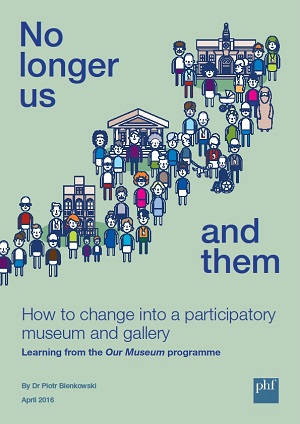
In its first five years, Our Museum yielded real change at twelve diverse UK organizations. Our Museum also produced a suite of online resources and reports that are impressive, honest, and comprehensive (though a bit tricky to navigate--I recommend using the search function). You could spend a day getting lost in the meaty, thoughtful writing and videos on the Our Museum site. I recommend starting with the final report, No Longer Us and Them.
Our Museum started with a clear-eyed assessment of community engagement funding and practices across the UK. Dr. Bernadette Lynch's provocative 2011 report, Whose Cake is it Anyway?, didn't mince words. While there was evidence of plenty of community engagement work across museums and galleries, most of it was funded project by project. Most participatory projects were short-term, siloed innovations, not institutional transformations. And in several cases, the projects constituted "empowerment lite" for participants rather than true collaboration, co-creation, or transformation.
Five years later, project director Dr. Piotr Bienkowski's final report for Our Museum tells a different story. No Longer Us and Them describes organizations that have changed dramatically, from top to bottom and across program areas. I strongly recommend you read the report. Extra credit if you read the Our Museum evaluation (or its summary) as well. Here are my three top takeaways.
Institutional Change is about Change, No Matter the Focus
The two big lessons from Our Museum that Piotr identified are not about community engagement per se, but about institutional change:
- Small Changes Add Up.
- Participation is Everyone's Job.
These two lessons are probably true of any major institutional change process (swapping the word "participation" with the focus of the change). Many of the barriers to participation identified in the report--lack of committed leadership, conflicting strategic agendas, silos, staff resistance, lack of capacity, fear--could apply to any change process. The evaluation additionally called out some faulty assumptions in program design about leadership and staff continuity throughout the multi-year process. Disruption can be confusing, destabilizing, and potentially derailing, no matter the focus of the transformation at hand.
Interestingly--for good and ill--this transformative funding program coincided with a national funding crisis in the arts in the UK. This made the work more urgent, fragile... and realistic. Most major change doesn't happen when things are going well. While a funder can have impact in directing organizational leaders to turn their heads in a particular direction, it's often negative externalities--financial pressure, political changes--that spur organizations to significant action. The financial austerity measures applied external pressure to the Our Museum institutions. While that was painful for the organizations involved, it also helped force the issue of whether participatory engagement could be core to a strong future business model for each organization or not. It upped the stakes on change--something a funder could not provide alone.
Different External Voices Bring Different Skills to the Table
Community partners, artists, peers, and funders all play different roles as collaborators and contributors to participatory institutions. My favorite section of No Longer Us and Them is the discussion of the specific value and roles of each type of outside contributor (scroll down in this document for a helpful visual representation).
In particular, Piotr calls out "critical friends" as helpful external partners. Critical friends are trusted outside observers who may raise tough questions and uncomfortable truths that a collaborating community group cannot or will not share. Critical friends are positive, constructive, and able to tease out real challenges. As this video points out, critics make you swear. Critical friends can make you smile.
Piotr also notes that artists, while excellent at providing fresh perspectives on an institution's work, may not be the most helpful or well-received when it comes to providing more formal feedback or participating in reflection and shared learning sessions. While I don't fully agree with all the role designations in the report, I appreciate the nuanced insight that different types of outside contributors bring different expertise and value to the table.
Watch Out for Things to Watch Out For
No Longer Us and Them's magic ingredient is honesty. That honesty shines through in the report's clear language, specific tips, and frequent bite-sized notes of "things to watch out for" when working to become a participatory organization. Indicated with a bold exclamation point, the "things to watch out for" are warning signs and traps to avoid. Some feel small and specific--"be sensitive to staff body language in meetings"--whereas others are more strategic--"be clear about your starting point when you approach communities." In all cases, I found these warnings to be refreshing, educational insights that taught me more than any success stories could.
In summary: read the report. Check out the Our Museum online resources. Consider your own path to institutional transformation. And consider sharing a comment here with a takeaway that is meaningful for you.
If you are reading this via email and would like to share a comment or question, you can join the conversation here.
Does the Most Powerful Work Live Onstage or Behind the Scenes?
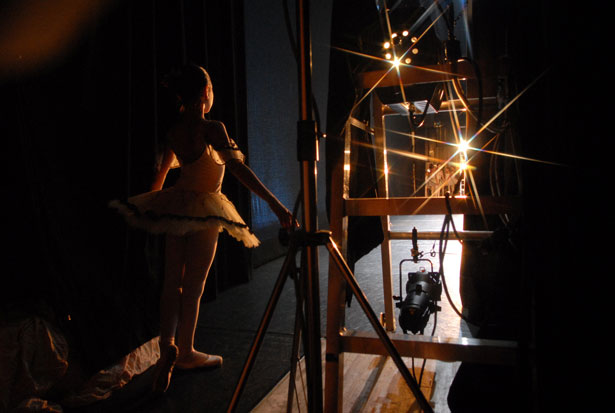
The more my organization has become focused on community engagement, the more we've balanced being experience producers with being experience co-creators/facilitators. We still produce exhibitions, events, and educational programs for an audience, but that audience is just one of our major constituencies. The partners we work with--to catalyze projects within and beyond our walls--are just as important as our visitors to fulfilling our mission. Relative to other museums, I think we spend less time producing an "onstage" experience and more time collaborating with community organizations behind the scenes to empower them to produce.
I feel great about this approach. It enables us to authentically and meaningfully involve diverse people in the museum, empowering them as creative agents, building community together, and leveraging their passion to reach more (and more diverse) people.
But this approach leads to a strategic puzzle as we consider our future as an institution. Our museum is growing, and I'm always weighing different ways to expand our impact. Should we focus more on empowering and connecting partners behind the scenes, becoming more of a resource to creative colleagues across our community? Or should we focus more on what's onstage for our growing audience of participants--empowering and connecting them?
But this approach leads to a strategic puzzle as we consider our future as an institution. Our museum is growing, and I'm always weighing different ways to expand our impact. Should we focus more on empowering and connecting partners behind the scenes, becoming more of a resource to creative colleagues across our community? Or should we focus more on what's onstage for our growing audience of participants--empowering and connecting them?
In behind-the-scenes mode, we could devote more resources to supporting projects beyond our building, content area, and program formats. I see how we extend our impact and build community through dedicated partnerships, thoughtful bridge-building, and advocacy work. If we can help other sympatico organizations achieve their goals--while advancing our goals and mission along the way--that's powerful.
On the other hand, in onstage mode, we could present more highly visible opportunities for people to be empowered and connected through art and history. I see how we ignite excitement, curiosity, and community pride through powerful exhibitions, compelling stories, and dynamic festivals. We could do the work directly with more people, achieving impact with those participants and serving as a model for others interested in this kind of work. If we can make our mission more overt for more people, that's powerful too.
I've been trying to think of examples of superlative organizations of each type. I think of Springboard for the Arts, Alternate Roots, and A Blade of Grass as leaders from behind the scenes. They all merge clear, radical visions with innovative work to empower other organizations to manifest those visions. They are funded primarily by foundations (or are foundations themselves). They exist to improve for their fields or their communities, but not primarily through direct service. We need more empowerment in this world, and these institutions offer it.
Leading onstage institutions are more publicly-known and recognized. I'd put the Exploratorium, the American Visionary Art Museum, and the New World Symphony in this category. All of these organizations provide mind-blowing audience experiences and serve as inspiring models for their fields. By being onstage as visible, powerful beacons of a particular methodology, they both engage audiences and inspire other institutions to consider adopting some of their approaches. We need more magic in this world, and these institutions offer it.
Leading onstage institutions are more publicly-known and recognized. I'd put the Exploratorium, the American Visionary Art Museum, and the New World Symphony in this category. All of these organizations provide mind-blowing audience experiences and serve as inspiring models for their fields. By being onstage as visible, powerful beacons of a particular methodology, they both engage audiences and inspire other institutions to consider adopting some of their approaches. We need more magic in this world, and these institutions offer it.
And then, of course, there are many organizations that do both. Some are huge institutions, publicly known for onstage work but flexing serious behind-the-scenes muscles; for example, the San Diego Zoo and Monterey Bay Aquarium are both best-in-class for visitor experiences AND for conservation research and advocacy behind the scenes. Children's Museum of Pittsburgh is a terrific place to visit AND a leading force in diverse regional projects to support youth development. There are mid-sized and smaller organizations--like my museum and many, many others--balancing a public visitor experience with community service behind-the-scenes.
Do we have to choose one or the other? Not exclusively. But I think it's an important strategic question--one that could provide real focus and direction to our future growth. If we had to choose, would we focus on engaging visitors or empowering partners? Would we manage more sites directly, or would we support others in getting their sites off the ground? How can we make these decisions in service of our mission and our vision of a stronger, more connected community?
Where do you start in considering these questions?
The Art of Relevance Sneak Peek: Rock and Roll Family Edition

I've learned so much from my dad about making art, putting on a great show, inviting audience participation, and navigating celebrity. When writing The Art of Relevance, I knew I wanted to share a bit of his story and the ways artists negotiate the relevance of their own work. Here's that chapter.
RELEVANCE IS A MOVING TARGET FOR CONTENT
Most of us aren�t steering whole institutions and mission statements. We�re working on a smaller scale, with specific content or programs. But the changing tides of relevance that affect institutions affect content too�sometimes even more acutely. While an institution can pivot, presenting different content for different times, the content itself does not change. The painting is what it is.In the nonprofit arts, administrators maintain a polite silence about the reality that certain artworks, plays, composers, and stories fall in and out of favor at different times. No museum puts up a label that says: �Our last curator thought this painting was lousy and kept it in storage. Our new curator thinks it speaks to contemporary issues and put it front and center.� But we make those decisions and changes all the time. Institutionally, this is a question of moving around assets, elevating some stories and archiving others. But for the artists and objects involved, and for the people who care for them, these shifts can be dislocating. The work is the work. Sometimes it�s hot, sometimes not.
I saw this when we hosted the Princes of Surf exhibition in Santa Cruz. Before the MAH exhibition, those historic surfboards rested deep in the collection storage of the Bishop Museum in Hawaii. As royal boards, they were sufficiently relevant to the Bishop�s mission to be collected�but not compelling enough to warrant exhibition.
The boards were in storage for 90+ years before historians discov- ered they were the boards in the first known record of surfing in the Americas. The boards became rock stars in Santa Cruz. We paid a small fortune to have them conserved and shipped here for exhibition. Our community showed up in droves to honor them.
The surfboards were powerful in our community. They made magic at the MAH. But that power didn�t follow them back across the ocean. After their �blockbuster� run in Santa Cruz, the boards went back in storage at the Bishop Museum, where their relevance warrants preservation but little adoration. We sent them off on the journey home with a blessing and a sigh.
The shifting relevance of these surfboards is emotional. But they�re still just hunks of wood. They don�t have feelings. People do.
What does it feel like to watch your own relevance ebb and flow? I grew up with a front row seat to this shape-shifting as the child of a rock musician. My dad, Scott Simon, joined the band ShaNaNa when he was 21. Forty-five years later, he�s still with the band. It�s the only job he�s ever had.
ShaNaNa was a breakout group at the Woodstock festival, playing �50s songs at breakneck pace in gold lame� jumpsuits and grungy under- shirts. They went on to build successful careers as �oldies� musicians before the term existed. They were defiantly anti-relevant in the early 1970s, a counter-countercultural throwback barreling through two-minute pop songs in the era of twenty-minute jams. At the end of every show, my dad thumbed his nose at crowds of tens of thousands, yelling: �I�ve got one thing to say to you f***in� hippies. ROCK AND ROLL IS HERE TO STAY.� And the hippies cheered, they clapped, and they accepted ShaNaNa as part of the rollicking youth culture sweeping North America.
By the 1980s, ShaNaNa was mainstream. They were featured in the movie Grease. They hosted a TV variety show for four seasons. They became massively relevant as cultural icons, but more sanitized, less relevant to the youth culture that drives pop music. I spent school vacations in casino showrooms in Reno downing Shirley Temples while ShaNaNa entertained middle-class, middle-aged couples twice a night. In the 1970s, Bruce Springsteen opened for them. By the 1990s, their opener was an elephant.
Their audience aged with them, and they slid from hot to nostalgic. In the 2000s, ShaNaNa played state fairs. Then county fairs. Pops concerts at symphony halls. At one outdoor venue, their contract ended when the venue owners explained that ShaNaNa was attracting huge crowds of families and baby boomers� but not the 30-somethings who buy beer and generate profits. Their music was relevant to the crowd. Just not the right crowd.
Behind the scenes, ShaNaNa�s relevance splintered and bubbled up in ways no one could have guessed. In the late �70s and �80s, heavy metal rockers and punks showed up at ShaNaNa�s door, inspired by their early hard-driving music, anti-glam wardrobe, and street tough attitude. The Beastie Boys name-checked them as influences. They played birthday blowouts and political events and anniversary parties for long-time fans. And perhaps strangest of all, ShaNaNa�s most persistent household relevance seems to be as a crossword puzzle clue (___ Na Na), fitting in a convenient box for hapless puzzle creators.
We can�t fight the reality that relevance shifts over time. But we can empathize with the dislocation, the highs and lows, that comes with those shifts. Spare a thought for a humble artifact in storage. Give respect to a hardworking musician. Their power is always there to be unlocked.
Learn more about The Art of Relevance and get your own copy here.
Subscribe to:
Posts (Atom)
-
 Some major changes have been occurring in the tropical Pacific. Most of the last winter was characterized by La Nina conditions in which th...
 -
 My daughter and I have been enthusiastic and faithful viewers of this year�s NHK Taiga drama, �Sanada Maru.� We looked forward to visiting ...
 -
 The Chiyoda Hotel in the Fushimi business district of Nagoya is an excellent value for money accommodation option, located roughly half-wa...