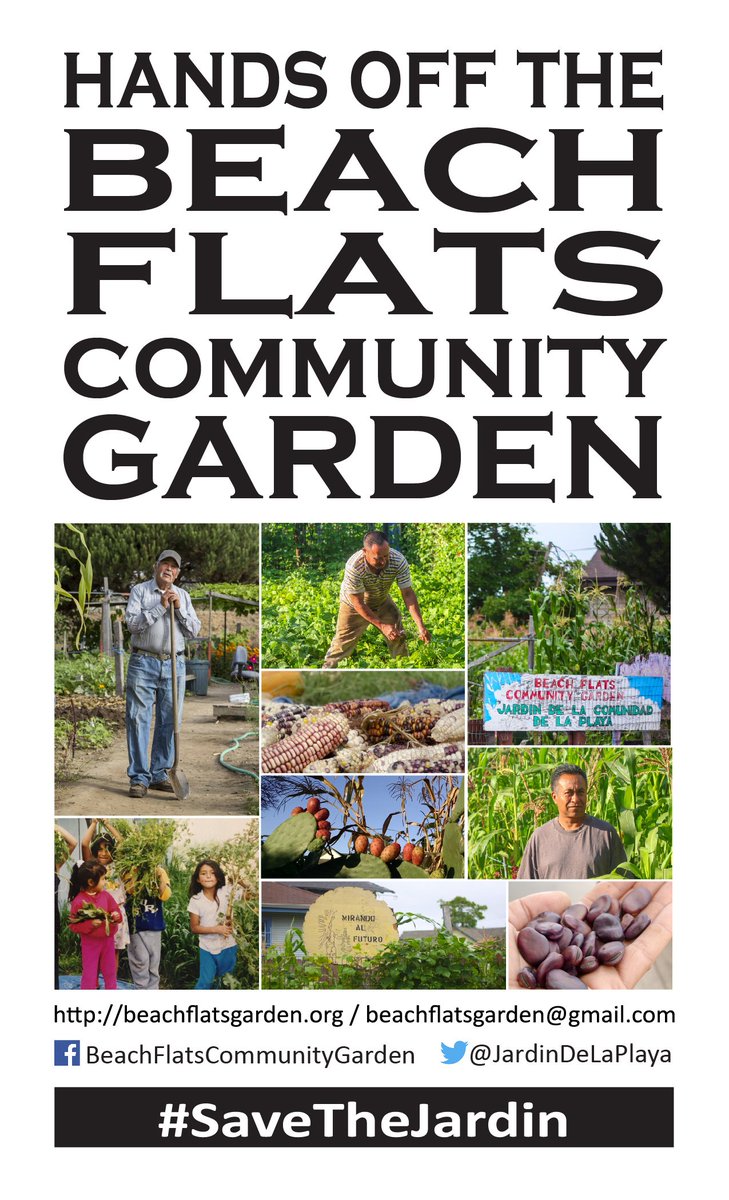
In October of 2015, I got a call from a community partner. The Beach Flats Community Garden was under threat, and this friend of the garden wanted our help. The garden, which had operated for 20 years in a predominately low-income Latino neighborhood near the beach, was losing its lease with a private property owner. The City proposed moving the garden to a nearby plot of City-owned land, but gardeners felt that this disruption would literally uproot an essential community place. Garden supporters and partners were putting together a petition to try to push the City and the property owner to find a long-term solution to allow the garden to remain in place. And so the collaborator on the phone asked: would I sign the petition on behalf of our museum?
The outside partner wasn't the only one asking. Several museum staff members had gotten involved in the political action personally outside of work, and they wanted to know if we could sign on organizationally. This wasn't just a question of what was moral or politically useful in the abstract. It was a question about our commitment to our partners, to local sites of cultural importance, and to the Latino families with whom we have been working intensely to build stronger relationships.
I watched as other partner organizations signed on, uncertain what to do. I didn't know how likely the petition was to have influence, but I knew that signing on was important to the people asking.
Ultimately, I decided we couldn't sign - not because it was the necessarily the wrong thing to do, but because we didn't have any kind of policy beyond directorial discretion to decide when it might be appropriate to take a political stand as an institution.
I took the issue to the board, and we agreed that we need to develop some kind of advocacy policy to be able to answer these phone calls with confidence. Our board/staff advocacy task force is meeting this Friday to get the work started, and so I'm curious: has your organization tackled this question? How have you addressed the challenges and opportunities to raise your institutional voice on local issues?
I'm going into this meeting with a strong feeling that our policy can't be to always say no. Our museum has a growing advocacy component to our work. Our theory of change focuses on an intended impact of building a stronger, more connected community. We already embrace the reality that manifesting that impact requires work beyond our building, beyond traditional museum activities. We are proud of our wide-ranging community partnerships, proud to amplify unsung voices and stories, proud to tackle issues of equity and social justice through our programming.
But that's all work we do on our terms. What good are we as a partner if we can't step up and support our partners on their terms, too? I'd hate to be the kind of organization that embraces partners when we need them but not when they need us.
I don't have an opinion about whether our eventual policy should have enabled us to sign that particular petition. But I do want to see us develop a policy that enables us to address these opportunities thoughtfully, with our mission, theory of change, and community values at heart.
How have you, or would you, go about this? What resources might be helpful as we embark on this work?
If you are reading this via email and would like to share a comment or question, you can join the conversation here.
Give Yourself Some SPACE in 2016
Every once in a while I look at my growing toddler and think: time will never go backwards. She'll never be this age again. Sometimes, that's a relief. Sometimes, the thought invokes pre-nostalgic fear. But mostly, watching her grow reminds me that time keeps moving relentlessly forward, whether we like it or not.
How do we tackle the problem of time? Some people attack the problem by sleeping less. Some seek to maximize and quantify time, building personal efficiency engines to squeeze out a few more seconds or minutes of joy each day.
In 2016, I'm choosing to take a different approach, inspired by Albert Einstein. I'm confronting the problem of diminishing time by making more space.
When you make space for yourself and others--physically or metaphorically--you expand your world. I've always loved the idea of "space-making" as a strategy for personal care and interpersonal empowerment. This past summer, my museum hosted a retreat for diverse professionals to explore space-making in deep ways. We talked about it. We shared tips and what ifs. We tested out each other's preferred ways of making space, and we tried to develop new space-making solutions to each other's problems.
The result is the Space Deck - 56 ways to make space for yourself and others. 100 extraordinary campers developed hundreds of different spacemaking ideas, which we developed, tested, and distilled into this deck of 56.
Just like a deck of playing cards, The Space Deck is divided into suits, representing different ways to make space through STILLNESS, CREATIVITY, COURAGE, ACTIVISM, RELATIONSHIPS, MOVEMENT, RITUAL, and ENVIRONMENT.
The Space Deck addresses frequent questions at work, like "how can we make space for everyone's voice to be heard in this meeting?," as well as personal questions, like "how can I find some peace in a world of chaos?" The cards share techniques that help you tackle your fears, declutter your mind, connect with your senses, and confront injustice.
You can check out all the spacemaking cards by suit on the Space Deck website. But if you prefer to hold space in your hand (Einstein would approve), you can buy your own personal deck to have and hold. Special thanks to Beck Tench, Elise Granata, Jason Alderman, and all the MuseumCampers who co-created the Space Deck together. All proceeds from Space Deck sales will support future creative retreats and camper scholarships.
Time won't slow down. Instead of trying to race time or trick it or beat it into submission, buy yourself some space in 2016. You'll be amazed how roomy it makes the day.
How do we tackle the problem of time? Some people attack the problem by sleeping less. Some seek to maximize and quantify time, building personal efficiency engines to squeeze out a few more seconds or minutes of joy each day.
In 2016, I'm choosing to take a different approach, inspired by Albert Einstein. I'm confronting the problem of diminishing time by making more space.
When you make space for yourself and others--physically or metaphorically--you expand your world. I've always loved the idea of "space-making" as a strategy for personal care and interpersonal empowerment. This past summer, my museum hosted a retreat for diverse professionals to explore space-making in deep ways. We talked about it. We shared tips and what ifs. We tested out each other's preferred ways of making space, and we tried to develop new space-making solutions to each other's problems.
The result is the Space Deck - 56 ways to make space for yourself and others. 100 extraordinary campers developed hundreds of different spacemaking ideas, which we developed, tested, and distilled into this deck of 56.
Just like a deck of playing cards, The Space Deck is divided into suits, representing different ways to make space through STILLNESS, CREATIVITY, COURAGE, ACTIVISM, RELATIONSHIPS, MOVEMENT, RITUAL, and ENVIRONMENT.
The Space Deck addresses frequent questions at work, like "how can we make space for everyone's voice to be heard in this meeting?," as well as personal questions, like "how can I find some peace in a world of chaos?" The cards share techniques that help you tackle your fears, declutter your mind, connect with your senses, and confront injustice.
You can check out all the spacemaking cards by suit on the Space Deck website. But if you prefer to hold space in your hand (Einstein would approve), you can buy your own personal deck to have and hold. Special thanks to Beck Tench, Elise Granata, Jason Alderman, and all the MuseumCampers who co-created the Space Deck together. All proceeds from Space Deck sales will support future creative retreats and camper scholarships.
Time won't slow down. Instead of trying to race time or trick it or beat it into submission, buy yourself some space in 2016. You'll be amazed how roomy it makes the day.
Can We Talk about Money? Tweetchat on #RadicalGiving December 18
On December 18, at 10am PT/1pm ET, I invite you to join the denizens of Museum 2.0, Museum Commons, and Incluseum for a 30-min tweetchat about how and why we can give for change at #RadicalGiving. We've each written some preliminary thoughts about giving to prime the tweetchat. Here are my reflections (theirs are at the links above). Please join us on Friday on twitter to talk more.
I remember the first time I asked someone for money. I had just taken the job as director of a museum that was struggling financially. If we didn't raise substantial funds in my first few weeks on the job, we'd have to close our doors.
I stood in my bathroom, looking in the mirror. I tried saying, "Can I count on you for ten thousand dollars?" without choking or bursting out laughing.
The first few times I asked for money--heck, the first few years--it felt awkward. But it also felt amazing. I saw how we were able to garner support for work I was passionate about. How we could build a more relevant and valued museum. How we could expand our impact. How donors could be partners in change. I learned the addictive power of asking.
The more I asked, the more I found myself thinking about giving. I started asking on behalf of other organizations I care about. My husband and I started being more intentional, and bolder, with our own giving. The more I asked, the more people asked me. Even with limited means, I saw how our own giving could make a difference.
At the same time, I became more and more aware of the screwed-up societal inequities that make philanthropy possible. One of the ways we redistribute wealth in an inequitable society is by asking rich people to voluntarily donate. And then we celebrate their generosity, rarely questioning why they had the capacity to give in the first place. Especially in the arts, research shows an alarming imbalance in what kinds of organizations have access to grants and donations. Our system of philanthropy often reinforces the inequity that it theoretically has the power to disrupt.
I decided that in my own limited way, I wanted to contribute in two ways:
That's on the personal side. Professionally, I've always struggled with what organizations to support--especially in museums and the arts. I admire many around the world. I can't support a fraction of those I love. How should I narrow the field?
Bearing in mind the data on who has access to philanthropic capital, I've decided to give to organizations that are rooted in and/or led by communities of color. This year, that included: Rainier Valley Corps, a Seattle-based leadership development program for people of color; the Laundromat Project, a New York-based neighborhood arts organization working in communities of color; and the South Asian American Digital Archive, about which I know little but was encouraged to support by a colleague volunteering her time to a project of mine.
These are organizations that inspire me. I've learned from their work and their leaders. I'm trying to more frequently convert my admiration into cash--just as I encourage people to do as a fundraiser for my organization every day.
I've noticed that the more time I spend fundraising as part of my job, the more comfortable I get talking about money. Money has become a currency of my work. I talk about it. I think about it. I treat it the same way I treat ideas and people and objects and stories. It is an essential, powerful part of getting the work done.
I realize that not everyone is comfortable talking about philanthropy, or about money. When we do so in our field, we're often focused on pay inequities for the work that we do. But pay and philanthropy are two separate topics. We should be willing to talk about both.
Talking about money is like talking about death. The more we do it, the more we are in control of our own fates. Talking about money helps us honestly and unflinchingly tackle challenges we face in our society. The more I talk about it, the more power I see it has--and the more I feel I have an ability to influence that power, however small my influence might be.
Many professionals--myself included--have the capacity to give. We give as donors. We give as volunteers. Let's not be silent about this giving. We can be leaders with our dollars and our time. We can influence change when we put our money where our hearts are.
As alluded to above, topics like the role of money, or the equivalent (time/work), in bringing about radical inclusive change are little discussed in our field.
We have some questions we want to pose to YOU in an upcoming #RadicalGiving Tweetchat on December 18 at 10am PT / 1pm ET.
Below, find some questions that came from our joint discussion on these subjects and that we will ask for your responses on during the tweetchat:
I remember the first time I asked someone for money. I had just taken the job as director of a museum that was struggling financially. If we didn't raise substantial funds in my first few weeks on the job, we'd have to close our doors.
I stood in my bathroom, looking in the mirror. I tried saying, "Can I count on you for ten thousand dollars?" without choking or bursting out laughing.
The first few times I asked for money--heck, the first few years--it felt awkward. But it also felt amazing. I saw how we were able to garner support for work I was passionate about. How we could build a more relevant and valued museum. How we could expand our impact. How donors could be partners in change. I learned the addictive power of asking.
The more I asked, the more I found myself thinking about giving. I started asking on behalf of other organizations I care about. My husband and I started being more intentional, and bolder, with our own giving. The more I asked, the more people asked me. Even with limited means, I saw how our own giving could make a difference.
At the same time, I became more and more aware of the screwed-up societal inequities that make philanthropy possible. One of the ways we redistribute wealth in an inequitable society is by asking rich people to voluntarily donate. And then we celebrate their generosity, rarely questioning why they had the capacity to give in the first place. Especially in the arts, research shows an alarming imbalance in what kinds of organizations have access to grants and donations. Our system of philanthropy often reinforces the inequity that it theoretically has the power to disrupt.
I decided that in my own limited way, I wanted to contribute in two ways:
- by developing a strategy for my own giving that helps boost organizations that have powerful impact AND are more subject to philanthropic inequity than others.
- by trying, where I can, to talk more openly with friends and colleagues about philanthropy.
That's on the personal side. Professionally, I've always struggled with what organizations to support--especially in museums and the arts. I admire many around the world. I can't support a fraction of those I love. How should I narrow the field?
Bearing in mind the data on who has access to philanthropic capital, I've decided to give to organizations that are rooted in and/or led by communities of color. This year, that included: Rainier Valley Corps, a Seattle-based leadership development program for people of color; the Laundromat Project, a New York-based neighborhood arts organization working in communities of color; and the South Asian American Digital Archive, about which I know little but was encouraged to support by a colleague volunteering her time to a project of mine.
These are organizations that inspire me. I've learned from their work and their leaders. I'm trying to more frequently convert my admiration into cash--just as I encourage people to do as a fundraiser for my organization every day.
I've noticed that the more time I spend fundraising as part of my job, the more comfortable I get talking about money. Money has become a currency of my work. I talk about it. I think about it. I treat it the same way I treat ideas and people and objects and stories. It is an essential, powerful part of getting the work done.
I realize that not everyone is comfortable talking about philanthropy, or about money. When we do so in our field, we're often focused on pay inequities for the work that we do. But pay and philanthropy are two separate topics. We should be willing to talk about both.
Talking about money is like talking about death. The more we do it, the more we are in control of our own fates. Talking about money helps us honestly and unflinchingly tackle challenges we face in our society. The more I talk about it, the more power I see it has--and the more I feel I have an ability to influence that power, however small my influence might be.
Many professionals--myself included--have the capacity to give. We give as donors. We give as volunteers. Let's not be silent about this giving. We can be leaders with our dollars and our time. We can influence change when we put our money where our hearts are.
***
As alluded to above, topics like the role of money, or the equivalent (time/work), in bringing about radical inclusive change are little discussed in our field.
We have some questions we want to pose to YOU in an upcoming #RadicalGiving Tweetchat on December 18 at 10am PT / 1pm ET.
Below, find some questions that came from our joint discussion on these subjects and that we will ask for your responses on during the tweetchat:
- Q1A. What is your personal motivation to give to support inclusive change and those who are leading change?
- Q1B. How do you give?
- Q2. What do you give your time/money to? Let�s signal boost these projects and efforts!
- Q3. How can we have these conversations about money more in museums?
- Q4. If money talks, how can we influence the conversation?


The front made it in late this afternoon and early evening as shown by the infrared satellite photo above. Winds really increased this afternoon as the front approached as winds reached 20-25 mph in places. If you look carefully, you will see the mottled cloud pattern over the ocean...those are the classic postfrontal instability showers produced by cooler air aloft over warmer water. You will notice an area of enhanced showers out there...that is associated with an upper level trough (see map for 500 mb, the lines give the height of this pressure above sea level). So expect showers and sunbreaks tomorrow.
The latest radar image shows the frontal precipitation on the east side of the sound and an area of enhanced showers from Sequim to Whidbey Island...this is from a convergence zone to lee of the Olympics...since winds are now from the SW aloft. All convergence zones are not over Puget Sound! It all depends on the wind direction.
Nice Weekend and then Downhill a bit
I returned on Friday from a workshop in Boulder, Colorado on developing the next generation weather prediction system. Such a system would be essentially probabilistic in nature---rather than giving a single answer as we do today. It really doesn't make sense to say the high temp at Seattle in seven days will be 67F--there is substantial uncertainty in the answer and that uncertainty depends on the situation. My field is developing the technologies to provide uncertainty information--including probabilities of much more than precipitation. This is a major revolution in the way we do business. But is the population ready for this? Will they accept and use it?
While I was in Boulder it snowed! On Wednesday, there were snow flakes in the air, with temperatures dropping into the upper 30sF. Being over 5000 ft and open to the cold air to the north really helps.

This weekend will be moderate in temperature and very nice here in the NW. Look at the latest satellite image (above). You will notice some residual low clouds from a dissipating front that moved through this morning. But skies will clear and temps should rise into the mid and upper 60s for most of the west.
Tomorrow will be even nicer. High pressure (ridging) will develop aloft and its surface manifestation will be high pressure to our east (figure). You know what that implies...offshore flow and compressional warming as air descends the western slopes of the Cascades (see figure). Our friend the thermal trough will be back. So tomorrow will be sunny with many temps rising into the upper 60s and lower 70s.

Monday really won't be too bad. A week front will approach...but will not arrive until late in the day. Thus, most of Monday will be dry, but with increasing clouds and chance of showers very late in the day.
Tuesday should be cooler and showery...but really nothing to write home about.
So enjoy a very nice weekend....
Big Daily Temperature Range and Foothills Heat

Today was hot, with many locations getting into the mid and upper 80s, and some foothills locations reaching into the 90s (see map of temps and winds at 5 PM). Why the foothills? The reason is we had fairly strong easterly flow today with downslope flow and compressional warming of the air descending the slopes. (see Seattle profiler winds and temps to see the easterly flow and warming aloft). North Bend is a favorite place for hot temps on such days because it is at the
base of the Cascades and gets the maximum downslope heating. Hint: during the late fall it is sometimes MUCH warmer near North Bend and the foothills than anywhere else--good place for a hike or bike ride!Last night there was good radiational cooling to space (since we had clear skies) and temperatures fell over most of the region...but near the foothills the temps really held up due to the downslope. See for yourself with the weather map at 7 AM. Over 70F in the foothills...but in the 50s and 40s elsewhere!

Another interesting aspect of temps today have been the large diurnal (daily) temperature range...something we frequently see in the fall under these conditions. With full sun and downslope offshore flow the temperatures can still get quite warm during the day, but the nights are getting much longer now (unfortunately for my tomatoes), and with clear skies there is good radiational cooling to space. Today, many locations were in the 40s this morning and skyrocketed to near 90F....nearly a 50F change over roughly six hours. That will crack some concrete! Don't believe me? Take a look at the temps at Shelton today (graph), where the temperature climbed from 41 to 89 over a few hours!

Tomorrow (Wed) will be slightly cooler and a marine push will occur tomorrow night....ending the heat wave. But no major weather in sight.
Super-Ridge and Late September Heat Wave

Last week I was in California...dropping my son off at college and visiting Yosemite Park. It was hot down there...even reaching 90F in the Yosemite Valley, but that is nothing compared to what is going to happen during the next few days--both down there and up here in the NW.
Take a look at the temperatures of the past two weeks (see figure above). In general, the high temps have been at or above normal...and the minimum temperature much above normal. But real heat is about to turn on.
A huge, high-amplitude upper ridge is developing over the west coast (see forecast for Tuesday morning). This is really amazing...with unusually high pressure developing aloft and at low levels. Such a major ridge is associated with warm temps aloft and with offshore flow and added warming at low levels. Look at the computer forecast for Tuesday (see figure). Very, very warm temps in California, offshore and downslope flow over the Cascades, warming over our region. Notice the development of the "thermal" trough into western Oregon and Washington....the classic warm weather pattern.
Western Washington should surge into the mid-70s tomorrow and mid-80s on Wednesday and Thursday. Impressive for late September! And I have no plans to return to California where temperatures of purgatory will abound. A heat warning is up for the SF Bay Area where some interior locations will get well into the 100s. Yosemite Valley will be in the mid 90s.
And don't forget the Willamette Valley...where temperatures will climb into the 90s. The Willamette is often 5-10F warmer than the western Washington interior...frequently even warmer.

Subscribe to:
Posts (Atom)
Not A Great Deal Seems To Have Happened In the Last Few Years. Really Pretty Hopeless.
For some reason Google found this for me today � and note the article date. Dr Mukesh Haikerwal Resigns from NEHTA By Petrina Smith Friday, ...
-
Some major changes have been occurring in the tropical Pacific. Most of the last winter was characterized by La Nina conditions in which th...
-
My daughter and I have been enthusiastic and faithful viewers of this year�s NHK Taiga drama, �Sanada Maru.� We looked forward to visiting ...
-
The Chiyoda Hotel in the Fushimi business district of Nagoya is an excellent value for money accommodation option, located roughly half-wa...

