Our Museum: Extraordinary Resources on How Museums and Galleries Become Participatory Places

Six years ago, the Paul Hamlyn Foundation set out on an ambitious quest. They wanted to help museums and galleries across the UK make significant, sustained changes in the ways they engage community partners and visitors as participants in their work. The result, Our Museum, is an extraordinary funding program with a focus on community participation.

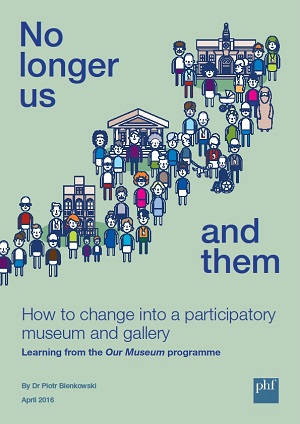
In its first five years, Our Museum yielded real change at twelve diverse UK organizations. Our Museum also produced a suite of online resources and reports that are impressive, honest, and comprehensive (though a bit tricky to navigate--I recommend using the search function). You could spend a day getting lost in the meaty, thoughtful writing and videos on the Our Museum site. I recommend starting with the final report, No Longer Us and Them.

Our Museum started with a clear-eyed assessment of community engagement funding and practices across the UK. Dr. Bernadette Lynch's provocative 2011 report, Whose Cake is it Anyway?, didn't mince words. While there was evidence of plenty of community engagement work across museums and galleries, most of it was funded project by project. Most participatory projects were short-term, siloed innovations, not institutional transformations. And in several cases, the projects constituted "empowerment lite" for participants rather than true collaboration, co-creation, or transformation.

Five years later, project director Dr. Piotr Bienkowski's final report for Our Museum tells a different story. No Longer Us and Them describes organizations that have changed dramatically, from top to bottom and across program areas. I strongly recommend you read the report. Extra credit if you read the Our Museum evaluation (or its summary) as well. Here are my three top takeaways.

Institutional Change is about Change, No Matter the Focus

The two big lessons from Our Museum that Piotr identified are not about community engagement per se, but about institutional change:
  • Small Changes Add Up. 
  • Participation is Everyone's Job. 
These two lessons are probably true of any major institutional change process (swapping the word "participation" with the focus of the change). Many of the barriers to participation identified in the report--lack of committed leadership, conflicting strategic agendas, silos, staff resistance, lack of capacity, fear--could apply to any change process. The evaluation additionally called out some faulty assumptions in program design about leadership and staff continuity throughout the multi-year process. Disruption can be confusing, destabilizing, and potentially derailing, no matter the focus of the transformation at hand.

Interestingly--for good and ill--this transformative funding program coincided with a national funding crisis in the arts in the UK. This made the work more urgent, fragile... and realistic. Most major change doesn't happen when things are going well. While a funder can have impact in directing organizational leaders to turn their heads in a particular direction, it's often negative externalities--financial pressure, political changes--that spur organizations to significant action. The financial austerity measures applied external pressure to the Our Museum institutions. While that was painful for the organizations involved, it also helped force the issue of whether participatory engagement could be core to a strong future business model for each organization or not. It upped the stakes on change--something a funder could not provide alone.

Different External Voices Bring Different Skills to the Table

Community partners, artists, peers, and funders all play different roles as collaborators and contributors to participatory institutions. My favorite section of No Longer Us and Them is the discussion of the specific value and roles of each type of outside contributor (scroll down in this document for a helpful visual representation). 

In particular, Piotr calls out "critical friends" as helpful external partners. Critical friends are trusted outside observers who may raise tough questions and uncomfortable truths that a collaborating community group cannot or will not share. Critical friends are positive, constructive, and able to tease out real challenges. As this video points out, critics make you swear. Critical friends can make you smile.

Piotr also notes that artists, while excellent at providing fresh perspectives on an institution's work, may not be the most helpful or well-received when it comes to providing more formal feedback or participating in reflection and shared learning sessions. While I don't fully agree with all the role designations in the report, I appreciate the nuanced insight that different types of outside contributors bring different expertise and value to the table. 

Watch Out for Things to Watch Out For

No Longer Us and Them's magic ingredient is honesty. That honesty shines through in the report's clear language, specific tips, and frequent bite-sized notes of "things to watch out for" when working to become a participatory organization. Indicated with a bold exclamation point, the "things to watch out for" are warning signs and traps to avoid. Some feel small and specific--"be sensitive to staff body language in meetings"--whereas others are more strategic--"be clear about your starting point when you approach communities." In all cases, I found these warnings to be refreshing, educational insights that taught me more than any success stories could.


In summary: read the report. Check out the Our Museum online resources. Consider your own path to institutional transformation. And consider sharing a comment here with a takeaway that is meaningful for you.  


If you are reading this via email and would like to share a comment or question, you can join the conversation here.

Does the Most Powerful Work Live Onstage or Behind the Scenes?

Let's say your organization has a mission to increase X (art, healthy kids, clean water, community cohesiveness, etc.). Is it more effective to produce X yourself or empower others to produce X in their own contexts?

The more my organization has become focused on community engagement, the more we've balanced being experience producers with being experience co-creators/facilitators. We still produce exhibitions, events, and educational programs for an audience, but that audience is just one of our major constituencies. The partners we work with--to catalyze projects within and beyond our walls--are just as important as our visitors to fulfilling our mission. Relative to other museums, I think we spend less time producing an "onstage" experience and more time collaborating with community organizations behind the scenes to empower them to produce.

I feel great about this approach. It enables us to authentically and meaningfully involve diverse people in the museum, empowering them as creative agents, building community together, and leveraging their passion to reach more (and more diverse) people.

But this approach leads to a strategic puzzle as we consider our future as an institution. Our museum is growing, and I'm always weighing different ways to expand our impact. Should we focus more on empowering and connecting partners behind the scenes, becoming more of a resource to creative colleagues across our community? Or should we focus more on what's onstage for our growing audience of participants--empowering and connecting them?

In behind-the-scenes mode, we could devote more resources to supporting projects beyond our building, content area, and program formats. I see how we extend our impact and build community through dedicated partnerships, thoughtful bridge-building, and advocacy work.  If we can help other sympatico organizations achieve their goals--while advancing our goals and mission along the way--that's powerful. 

On the other hand, in onstage mode, we could present more highly visible opportunities for people to be empowered and connected through art and history. I see how we ignite excitement, curiosity, and community pride through powerful exhibitions, compelling stories, and dynamic festivals. We could do the work directly with more people, achieving impact with those participants and serving as a model for others interested in this kind of work. If we can make our mission more overt for more people, that's powerful too.

I've been trying to think of examples of superlative organizations of each type. I think of Springboard for the Arts, Alternate Roots, and A Blade of Grass as leaders from behind the scenes. They all merge clear, radical visions with innovative work to empower other organizations to manifest those visions. They are funded primarily by foundations (or are foundations themselves). They exist to improve for their fields or their communities, but not primarily through direct service. We need more empowerment in this world, and these institutions offer it.

Leading onstage institutions are more publicly-known and recognized. I'd put the Exploratorium, the American Visionary Art Museum, and the New World Symphony in this category. All of these organizations provide mind-blowing audience experiences and serve as inspiring models for their fields. By being onstage as visible, powerful beacons of a particular methodology, they both engage audiences and inspire other institutions to consider adopting some of their approaches. We need more magic in this world, and these institutions offer it.

And then, of course, there are many organizations that do both. Some are huge institutions, publicly known for onstage work but flexing serious behind-the-scenes muscles; for example, the San Diego Zoo and Monterey Bay Aquarium are both best-in-class for visitor experiences AND for conservation research and advocacy behind the scenes. Children's Museum of Pittsburgh is a terrific place to visit AND a leading force in diverse regional projects to support youth development. There are mid-sized and smaller organizations--like my museum and many, many others--balancing a public visitor experience with community service behind-the-scenes.

Do we have to choose one or the other? Not exclusively. But I think it's an important strategic question--one that could provide real focus and direction to our future growth. If we had to choose, would we focus on engaging visitors or empowering partners? Would we manage more sites directly, or would we support others in getting their sites off the ground? How can we make these decisions in service of our mission and our vision of a stronger, more connected community?

Where do you start in considering these questions?

The Art of Relevance Sneak Peek: Rock and Roll Family Edition

Yesterday, the local paper in Santa Cruz published a great article about my new book, The Art of Relevance. I loved the piece... but I wished it could have included more of the conversation reporter Wallace Baine and I had about my father Screamin Scott Simon's experience as a rock musician in the band ShaNaNa.

I've learned so much from my dad about making art, putting on a great show, inviting audience participation, and navigating celebrity. When writing The Art of Relevance, I knew I wanted to share a bit of his story and the ways artists negotiate the relevance of their own work. Here's that chapter.

RELEVANCE IS A MOVING TARGET FOR CONTENT

Most of us aren�t steering whole institutions and mission statements. We�re working on a smaller scale, with specific content or programs. But the changing tides of relevance that affect institutions affect content too�sometimes even more acutely. While an institution can pivot, presenting different content for different times, the content itself does not change. The painting is what it is.

In the nonprofit arts, administrators maintain a polite silence about the reality that certain artworks, plays, composers, and stories fall in and out of favor at different times. No museum puts up a label that says: �Our last curator thought this painting was lousy and kept it in storage. Our new curator thinks it speaks to contemporary issues and put it front and center.� But we make those decisions and changes all the time. Institutionally, this is a question of moving around assets, elevating some stories and archiving others. But for the artists and objects involved, and for the people who care for them, these shifts can be dislocating. The work is the work. Sometimes it�s hot, sometimes not.

I saw this when we hosted the Princes of Surf exhibition in Santa Cruz. Before the MAH exhibition, those historic surfboards rested deep in the collection storage of the Bishop Museum in Hawaii. As royal boards, they were sufficiently relevant to the Bishop�s mission to be collected�but not compelling enough to warrant exhibition.

The boards were in storage for 90+ years before historians discov- ered they were the boards in the first known record of surfing in the Americas. The boards became rock stars in Santa Cruz. We paid a small fortune to have them conserved and shipped here for exhibition. Our community showed up in droves to honor them.

The surfboards were powerful in our community. They made magic at the MAH. But that power didn�t follow them back across the ocean. After their �blockbuster� run in Santa Cruz, the boards went back in storage at the Bishop Museum, where their relevance warrants preservation but little adoration. We sent them off on the journey home with a blessing and a sigh.

The shifting relevance of these surfboards is emotional. But they�re still just hunks of wood. They don�t have feelings. People do.

What does it feel like to watch your own relevance ebb and flow? I grew up with a front row seat to this shape-shifting as the child of a rock musician. My dad, Scott Simon, joined the band ShaNaNa when he was 21. Forty-five years later, he�s still with the band. It�s the only job he�s ever had.

ShaNaNa was a breakout group at the Woodstock festival, playing �50s songs at breakneck pace in gold lame� jumpsuits and grungy under- shirts. They went on to build successful careers as �oldies� musicians before the term existed. They were defiantly anti-relevant in the early 1970s, a counter-countercultural throwback barreling through two-minute pop songs in the era of twenty-minute jams. At the end of every show, my dad thumbed his nose at crowds of tens of thousands, yelling: �I�ve got one thing to say to you f***in� hippies. ROCK AND ROLL IS HERE TO STAY.� And the hippies cheered, they clapped, and they accepted ShaNaNa as part of the rollicking youth culture sweeping North America.

By the 1980s, ShaNaNa was mainstream. They were featured in the movie Grease. They hosted a TV variety show for four seasons. They became massively relevant as cultural icons, but more sanitized, less relevant to the youth culture that drives pop music. I spent school vacations in casino showrooms in Reno downing Shirley Temples while ShaNaNa entertained middle-class, middle-aged couples twice a night. In the 1970s, Bruce Springsteen opened for them. By the 1990s, their opener was an elephant.

Their audience aged with them, and they slid from hot to nostalgic. In the 2000s, ShaNaNa played state fairs. Then county fairs. Pops concerts at symphony halls. At one outdoor venue, their contract ended when the venue owners explained that ShaNaNa was attracting huge crowds of families and baby boomers� but not the 30-somethings who buy beer and generate profits. Their music was relevant to the crowd. Just not the right crowd.

Behind the scenes, ShaNaNa�s relevance splintered and bubbled up in ways no one could have guessed. In the late �70s and �80s, heavy metal rockers and punks showed up at ShaNaNa�s door, inspired by their early hard-driving music, anti-glam wardrobe, and street tough attitude. The Beastie Boys name-checked them as influences. They played birthday blowouts and political events and anniversary parties for long-time fans. And perhaps strangest of all, ShaNaNa�s most persistent household relevance seems to be as a crossword puzzle clue (___ Na Na), fitting in a convenient box for hapless puzzle creators.

We can�t fight the reality that relevance shifts over time. But we can empathize with the dislocation, the highs and lows, that comes with those shifts. Spare a thought for a humble artifact in storage. Give respect to a hardworking musician. Their power is always there to be unlocked.


Learn more about The Art of Relevance and get your own copy here.

What Does Audience-Centered Look Like? It Looks like Glasgow Museums.

KelvingroveWhen we say we want our museum to be "audience-centered," what do we mean?

Over the past decade, I've seen two distinct versions of this term:
  1. the user-centered museum, in which visitors are active participants, invited to contribute to and co-create the experience
  2. the customer-centered museum, in which visitors are valued guests, invited to enjoy personalized experiences that cater to their specific needs and interests
It will be no surprise to hear that I fundamentally align with the user-centered model. However, I have enormous respect for the customer-centered model when it is executed in ways that truly invite visitors in on their own terms and deliver satisfying experiences. My career first got moving at a brilliant example of the customer-centered museum: the International Spy Museum. Many of my favorite museums, libraries, and zoos are customer-centered places. They care about visitor comfort. They deliver learning experiences at many levels, engaging many senses. They are responsive to visitors' needs and interests, and they are willing to tailor their offerings to better satisfy those visitors.

To be clear: I'm not a fan of all aspects of customer-centered museums. At their worst, instead of human-centered, they become commerce-centered institutions, overly focused on the shop, the restaurant, the spectacle, and the highest ticket price the market can bear. But at their best, they focus on the humans walking in the door, providing them with value on their own terms. One hundred years ago, John Cotton Dana, founder of the Newark Museum and godfather of modern museums, famously said: �A great department store, easily reached, open at all hours, is more like a good museum of art than any of the museums we have yet established." I believe that Dana's department store museum is best exemplified in the customer-centered museum. The customer may not always be right, but she deserves to have an experience that brings her comfort, satisfaction, and joy.

I felt that comfort, satisfaction, and joy on a recent visit to two museums in Glasgow: Kelvingrove Art Gallery and Museum and Riverside Museum. Kelvingrove is an encyclopedic museum, the kind where pachyderms, mummies, and Impressionists rub shoulders. Riverside is a museum of transportation, packed with trains, bicycles, and motorcars. Both of these museums delivered incredible experiences for me and my husband. These museums were terrific examples of customer-centered institutions because:
  • They engaged our curiosity. The objects were interesting, the stories surprising. At Kelvingrove, a display of knights, swords, and shields (one I'd usually skip) was peppered with animals whose skin and scales formed body armor, drawing me to look closer and better understand the connections between how living creatures defend ourselves. At Riverside, a torn-up Ford Escort explained how car thieves cut up and weld together stolen chassis, displaying the ingenuity and dangerous implications of chop shops. These displays were memorable. They taught us something new. They prompted dialogue and a desire to keep looking.
  • They catered to different audiences. Kelvingrove in particular was impressive for embracing an eclectic, "we all belong here" approach to gallery design and display. You could come for the Scottish first peoples or the World War II art or the dinosaurs or the collection of funny shoes. All were given value. I never felt like I stumbled into the gallery where no one else dares to tread (as I often feel when I enter the dioramas in many natural history museums, or the period rooms of art institutions). And they did a good job calling out and tailoring areas for families and young ones without making those spaces feel segregated from the overall experience.
  • They offered immersive, powerful environments. Both institutions made good use of their very different spaces. Kelvingrove is in a hundred-year-old palace of galleries around a central court in a park, whereas Riverside is a 2011 Zaha Hadid open-plan warehouse on a riverfront with a dramatic contemporary exterior. In Kelvingrove, we strolled easily from gallery to gallery, through open thresholds that encouraged exploration while maintaining distinct character from room to room. At Riverside, we wandered from display to display around the open floor, again, feeling comfortable, accommodated, and stimulated by bicycles racing around a velodrome overhead and 1920s buses squatting on the concrete. The objects in both museums were varied, and the display techniques incorporated movement, varied sight lines, juxtaposition, and humor to keep us intrigued and engaged.
  • They offered genuinely interesting learning experiences. In each museum, we saw thematic displays and labels that surprised and engrossed us. At Kelvingrove, we were particularly taken by Looking at Art, a gallery that invited us to check out a painting in various stages of restoration, to look at the backs of paintings and the things that were crossed out, and to learn more about the stories and influences behind specific artworks. I'd seen each of these kinds of elements in other museums, but never in such a clear way that respected visitors' intelligence and provided us with genuinely new information. At Riverside, I was impressed by the consistent integration of community voices in label text, and the very human take on a genre (transportation) that is often presented strictly in terms of technology and provenance. There were displays about the terror of motorcycle accidents, the freedoms public transportation affords, and the ways vehicles can enable people to enjoy places that are otherwise inaccessible to them. I'd heard before about Riverside's development, which involved many community focus groups, workshops, and talkbacks. That work showed in the human voices and stories throughout the museum. Of course, these are tools of user-centered institutions! It was lovely to see their integration into such strong customer-centered experiences.
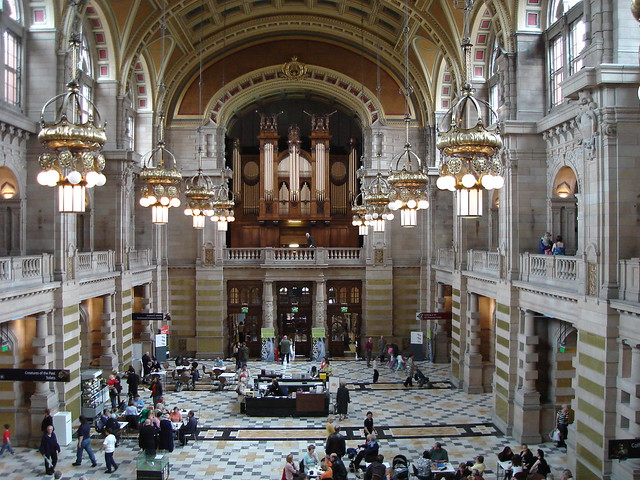
  • They acknowledged our desire for comfort and variation. One of the best bits of our trip to Kelvingrove was taking a break to enjoy the free pipe organ concert in the central court. We took a break from the galleries, had a drink, and listened to the music as we chatted about our experience. This kind of accommodation in museums is nothing new, but it was made special because of how it fit into the flow of the building. We didn't have to go outside or to some segregated area to have coffee. It was there, in the heart of the museum, where we could gaze up at the galleries we'd been to and the ones we'd skipped. It wasn't a destination or a set-aside place of respite; comfort and social activity were at the very center of the building.
It's interesting to note that Kelvingrove and Riverside, like all the Glasgow Museums, are part of a public charity called Glasgow Life. Glasgow Life oversees libraries, museums, arts events, music venues, sporting events and fields, and community services on behalf of the City of Glasgow. Their vision statement is "to inspire Glasgow's citizens and visitors to lead richer and more active lives through culture and sport." In pursuing this vision statement and this diverse work, Glasgow Life recognizes serving a community means being both user- and customer-centered. Sometimes we are customers and sometimes we are users. Sometimes we are watching the match and sometimes we are kicking the ball. Sometimes we are enjoying the music and sometimes we are playing it.

Glasgow Museums include other institutions--notably, Glasgow Open Museum--that are far more user-centered. (Glasgow Open Museum, which co-creates exhibitions with and in community spaces across the city, served as a case study in The Participatory Museum.) But as a tourist on a summer day, I didn't seek out that user-centered institution. Instead, I walked into Kelvingrove and Riverside--two fine department stores of humanity--and walked out a satisfied customer.

The Art of Relevance Sneak Peek: Part Ex-Con, Part Farmer, Part Queen

For the last time this summer, I'm sharing a chapter from my new book The Art of Relevance to celebrate its release. Read more online and buy your own copy today.

This chapter, from the last section of the book, is very personal to me. One of the nonprofits that inspires me locally here in Santa Cruz is a youth empowerment and food justice organization called "Food, What!?" FoodWhat's staff and teens have taught me a lot about what it really means to be relevant to people who are often overlooked or ignored. I firmly believe that all people have something meaningful to contribute to our communities, cultural work, and society at large--including youth. FoodWhat reminds me that it takes real work to unlock that meaning and invite teenagers to step into their own power. 

Part Ex-Con, Part Farmer, Part Queen


Each spring, Doron Comerchero walks into Pajaro Valley High School. The farmer-turned-activist is ready to sell struggling teenagers on something they may want in their hearts but don�t know how to access: a ticket to a meaningful life.

Doron runs a youth development program called FoodWhat in Santa Cruz County, California. FoodWhat empowers teens to change their lives through farming and food justice.

Doron doesn�t work with A students or B students. He works with kids who rarely show up to school. Kids with no food in the fridge. Kids on probation, kids struggling with addiction, kids whose lives have detoured off every map to a brighter tomorrow.

Doron believes in them. Doron supports them. And they turn their lives around.

But on day one of recruiting at Pajaro Valley High School, it is not obvious this will happen. Today, there are thirty kids fidgeting in a classroom, talking to their friends, messing with their phones. Doron�s wares, on the face of it, are a tough sell. Come work in the fields, grow organic vegetables, do leadership exercises, and eat healthy food. Most of these youth have bigger issues on their minds: addiction, gang violence, social anxiety, the possibility that they may not graduate from high school or get a good job. Many of them are desperate to avoid the exhausting, low-paid farming jobs their parents hold. Why would anyone want to sign up and be part of FoodWhat?

It starts�every time�with relevance. Doron knows that if his words aren�t relevant, the kids will shut him out. Shut themselves down. So he starts at the front door, with things that are obviously relevant to them. When Doron visits schools to invite teens to apply for FoodWhat, he gives a five-minute pitch on their terms.

First, Doron throws fruit to the crowd. It wakes the kids up, builds energy, and is relevant on a basic level to anyone who is hungry. Then, he establishes credibility with stories from real kids about the program. He shows a big board of photos of FoodWhat youth at work. Farming. Cooking. Eating. Hanging out. He strategically includes images of students from Pajaro Valley High, so when he asks, �See anyone you know on here?� the likely answer is �yes.� When there are FoodWhat alumni in the room, he asks them to share testimonials on the spot.

The easiest way to establish relevance�especially to something foreign�is to show that people like you, people you know, are involved. This is the front door. All you teenagers�this is the place for you.

Doron shows them the front door. Then he sets up the youth. He gets them to want to open the door. He answers the question on every teen�s mind: �what do I get if I participate in this program?�

Doron doesn�t answer this question with sweeping statements about personal transformation. He focuses on concrete things he knows are relevant to the teens in the room�especially the struggling teens who have the most to gain but are often the most reluctant to commit.

FoodWhat participants get four things. First, they get two school credits. While this may not matter to an A student, many struggling youth are miles away from the 200+ credits required to graduate. Those two credits matter to them. Second, participants get a $175 stipend if they successfully complete the program. It�s not a lot, but still, money is a huge motivator for these teens. Third, graduates of the spring program get first dibs on summer internships�real jobs paying a real hourly wage. Fourth, it looks good on your resume to complete a program like this. Many of the kids in the room may not know what a resume is, but Doron explains how it helps you get a job. He explains that FoodWhat graduates get jobs all over the community�that pretty much any place you might want to work, there�s probably FoodWhat alumni there. He says he will write a killer letter of recommendation for you, and when an employer is looking at two applications, that letter will move you to the top of the stack. And especially for those kids who know that their job prospects may be shaky, that sounds really good and useful.

Each of these four items is a potential key to the FoodWhat door. After offering up these four keys, Doron energizes the classroom with a challenge. He tells the kids: Don�t take an application if you aren�t serious. And if you are serious, make an impression on me when you turn in the application. Stand out in some way. This is a competitive program to get into, and the competition starts now.

He does all of this in five minutes. And kids come up to him, kids who were reassured that his program relates to them on the surface, kids who want to believe in themselves and have the slightest inkling this might help them do it. FoodWhat�s waiting list is always a distressing mile long.

The recruitment phase is just the start of FoodWhat�s relevance challenge. These are teenagers. When you talk about establishing relevance, teens are the holy grail. They are fickle. They are constantly distracted. They are self-centered. They have finely-tuned bullshit meters. They are not afraid to turn off their attention if something doesn�t seem to apply to them.

Teenagers don�t just need someone to help them open the door once. They need it again and again. For Doron, relevance is a process of constant reaffirmation and reconnection.

At the beginning of the FoodWhat year, it�s all about getting kids to show up. If they show up at the program, they�ll have a good day. Doron�s team spends the first few months helping youth open the door again and again. Texting kids to remind them to come. Picking up kids when they need a ride. Reaching out to kids who seem to be fading away. If they open the door enough times, they�ll figure out how to get into the room, and why it matters.

And that�s just getting in the door. Once they�re in the room, Doron�s team has a whole stack of techniques for going deeper with youth, helping them step into their own power on their own terms. He�s managing a mansion of opportunities for relevance and meaning.

What makes teenagers such a tough crowd? Developmentally, teens are in the midst of a huge shift of agency and self-knowledge. They wrestle to assert their identities and what is relevant to them in a sea of hormonal change and uncertainty. Before their teen years, children are sponges. They have very little agency, and as long as they are in supportive environments, they are mostly okay with that. They go where adults tell them to go. They are open to learning whatever someone else tells them is important. Relevance is not so relevant to them.

Adults, in contrast, have a lot of agency. They go where they want, choose what they want, learn what they want (within or in defiance of societal norms). Relevance is a heavy guiding hand in how adults live their lives. It is the internal voice suggesting what they might and might not want to do.

Teenagers are in the middle. They are developing self-knowledge, setting new boundaries, gaining a stronger sense of what they want and where they want to be. At the same time, their agency is still limited. They feel the friction of limited agency more acutely than their younger or older compatriots. Whenever they have some agency, they struggle to decide: is this relevant for me? Do I want to buy in? Or do I want to peel out?

In this way, teens are no different from adults who are trying something new. Think of the last time you brought something new into your life�a new activity, a lifestyle choice, a cuisine. As you sat there munching sushi for the first time, as you sweated it out in kickboxing, as you slid on that pair of skinny jeans, you probably asked yourself: is this me? Do I want this to be part of my life?

Teenagers ask themselves these questions all the time. But while most adults have a somewhat fixed sense of identity, teens� identities are in constant flux�which leads to a more complicated calculus of what is relevant, and why.

Because teens are still developing of their identities and goals, they don�t just care whether something is relevant to them now. They care whether something is relevant to who they may want to be�to their idealized perception of their authentic identity. For teens, every photo they share, every activity they opt in or out of, every outfit they wear, is part of establishing their desired identity. And so even as they seek relevance, they seek relevance to a shifting target. To the person they want to be, not necessarily the person they are.

FoodWhat does this in a deep way, providing teenagers with keys to safe spaces where they can explore their potential. As one FoodWhat alumna said at the 2015 graduation: �I used to steal cars. I was going down a bad path with the wrong people. But since my time at FoodWhat, I�m living differently. Now, I have purpose. I guess you can say I�m part ex-con, part farmer, part queen.�

These personal transformations start small. They start with relevance. Each week, Doron re-anchors the teens� time together on their terms. He reopens the door to the work they do together, ushering youth deeper into the opportunities before them. Each session starts with something that comes from the heart�not his heart, but the hearts of the kids in the room. Those starters don�t have to be complex. One day, the kids sit in a circle. Doron asks each teen: take a minute and think of a word that is most important to you. Then one at a time, the youth share their words and why they chose them. I�m Maria. Family is a word that matters to me. Michael. Loyalty. Jose. Happiness. Tawnesha. Trust.

Even farming tasks start with relevance. Instead of saying, �let�s go weed the onions,� Doron will say, �in two weeks, we want big fatty onions to put in the boxes that you take home to your parents or guardians and that we distribute out in the community.� That gets them excited. They want those fatty onions for their families. They want to be proud of their work. And then Doron might layer in some science: �Onions are shallow rooters, and so are these weeds, so if we take out the weeds, we give the onions more room to get big.� So now they know why they are weeding.

In a regular job, teens just get told, �do this.� But by providing twenty seconds of context, the task becomes relevant. Inspiring, even. And it communicates respect to the youth involved.

Doron and his team have shaped the room of FoodWhat into a safe space for youth to step into their own power. FoodWhat�s program- ming is relevant to the teens� struggles and dreams. This isn�t superficial relevance. It�s not �let�s talk about celebrities� relevance. It�s �open up your heart� relevance. The program invites youth to explore what matters most to them and who they want to be.
The Art of Relevance Sneak Peek: Whose Room is This?

This month, I'm sharing a few chapters from my new book The Art of Relevance to celebrate its release. Read more online and buy your own copy today.

One of my biggest aha moments while writing The Art of Relevance was moving away from the idea that there are "traditional" audiences and "new" audiences and instead thinking about people in terms of "insiders" and "outsiders". Here's a chapter from Part 2 of the book, Outside In, that explores the differences in how insiders and outsiders perceive institutional change. 


Whose Room is This?

I was a new parent, having lunch with a lesbian activist, when she told me the best-kept secret of hipster parenting in Santa Cruz: the Elks Lodge.

I knew the Elks Lodge as the weird building on the hill with an overabundance of wood paneling. The Elks, or the Benevolent and Protective Order of Elks as they are officially called, are a fraternal society of do-gooders founded in 1868. For over one hundred years, they accepted white men only. It took until the mid-1990s for women and people of color to be eligible for membership, and even then, most Elks Lodges stayed white, male, and aging.

But funny things were afoot at Lodge 824 in Santa Cruz. By 2015, the Elks Lodge had become a haven for LGBT parents of young children. I didn�t get it. I thought of the Elks Lodge community as a bunch of elderly guys at the bar. Then my friend explained: it was all about the pool.

The only public pool in the city of Santa Cruz was closed in the 2008 recession for four years. During that dry spell, a few enterprising families sought another place to take a dip. They noted that the Elks Lodge had a great pool, plus cheap drinks and a barbecue. So a few of them got sponsored by existing members, swore to believe in God and fight Communism, and they were in. Over time, they became a dominant force at the Lodge, taking on leadership positions and advocating for more active community involvement. They had trouble getting all the way in the room; elder Elks stuck to traditions like weekly board meetings during the workday that made it hard for newcomers to fully participate. But still, what was once a bar for old men expanded to become a community center for young families, led by a group of lesbians who only twenty years ago would have been shunned and excluded by the Elks.

You can read this story at least two ways. Is it a story about an old room made relevant for new reasons? Or is it a story about change and cooptation of someone�s sacred space?

In any situation where you are trying to make something relevant, what you are really trying to do is make it relevant to new people or more people. Unless it�s a brand new endeavor, you aren�t starting at zero. It�s already relevant to somebody. There were already Elks. There were already opera lovers. There were already insiders.

We all have our own personal Yellowstones, the insider places we want to protect from change. Embrace your inner insider for a moment. Think of something you love just as it is. A restaurant. A fictional character. An art form. A park. Now imagine someone saying publicly, �We are going to make X relevant to new people. We�re going to make some changes and open it up to new folks. We need to be more inclusive.�

When you are on the inside, this doesn�t sound like inclusive language. It sounds threatening. It sounds like the thing that you hold dear being adulterated for public consumption. Insiders often know the totality of an entity (or have constructed their own version of it). They have a clear story about what the entity is�and isn�t. And so reaching out to someone new doesn�t look additive. It looks like a shift away from what was. A dilution of services, a distortion of values. That shift means loss, not gain.

Outsiders have a different view. They can�t see the change the way insiders do. For them, relevance is a brand new door, an outstretched hand. It�s OK if at first only one part of an entity is relevant to someone new. The exhibition that speaks to their interests. The paved walking path around Old Faithful. The pool at the Elks Lodge. The entity wasn�t relevant at all previously, so if even a slice of its offerings are now relevant, the outsider has gained something worthwhile. Outsiders don�t want the room rearranged in their own image. But they do want to see reflections, expansions, and distortions of their experiences in ways that allow them to form new connections.

Anytime you look at an organization and think: �They�ve gone too far. They ought not to do that,� it�s worth asking yourself why. It�s rare that an entity adds something to their programming that is so divergent, and so powerful, that it injures other aspects of the institution. It may injure your idea of that institution, but it�s worth asking whether it really injures the entity itself. Is the room still intact? Is there still a place for you in it? That�s what matters.

To be relevant, we need to cultivate open-hearted insiders. Insiders who are thrilled to welcome in new people. Who are delighted by new experiences. The greatest gift that insiders can give outsiders is to help them build new doors. To say, I want you here�not on my terms, but on yours. I�m excited you think there might be something of value in this room. Let me help you access it.

Introducing: The Art of Relevance

Kid-tested, nonprofit-approved.
It's official. My new book, The Art of Relevance, is now available and ready to move from my computer to your hands.

I suggest at this point that you stop reading this post and go buy it. Right now.

Not convinced? Here's more about the book and what you can expect.

WHY I WROTE IT

I've been simultaneously energized and mystified by how often the word "relevance" comes up in the nonprofit world. Is it a fad? A core value? A revelation?

My institution has been waving the flag of relevance for years now. Relevance is one of our five engagement goals. We put a lot of work into developing ways to expand local relevance--to make meaningful connections with diverse people in our community. And yet, the more convinced I became about the value of relevance, the more unsure I was of what it actually means. I wanted to get beyond the buzzword. I wanted to learn more.

Last summer, a powerful encounter with two 130-year-old surfboards spurred me from curiosity to action. I dove into research and talked to dozens of people doing inspiring, surprising work around the world. I worked feverishly to translate their stories into a tight, poetic, enjoyable, useful form. The result is this book.

WHAT'S IN IT

The Art of Relevance is about how mission-based institutions can matter more to more people. By "mission-based institutions," I mean museums, libraries, theaters, parks, churches, synagogues, afterschool programs, informal science programs, zoos, aquaria, symphonies, historic sites, dance companies... all these and more are featured as case studies.

The Art of Relevance is not a how-to. It is not a definitive guide. It is the field notes from the quest I've been on for the past year to understand relevance and its ability to open new doors for new people to powerful, big, valuable experiences.

The book is separated into five sections:
  • What is Relevance? - definitions, delusions, and reality checks on what relevance can and cannot do
  • Outside In - exploring the different expectations and interests of insiders, who already love what you do, and outsiders, who are excluded or unaware of the value you offer
  • Relevance and Community - getting to a clearer definition of who you want to be relevant to and what they value and desire
  • Relevance and Mission - using your institutional mission as the foundation for making more meaningful connections with your community of interest
  • The Heart of Relevance - measuring relevance at the front door and at deeper levels of connection
The chapters are short, the stories are punchy, and there's a central metaphor that ties it all together. While the book focuses on institutional relevance, there are a lot of personal stories in the book too, and early reviewers commented on how much they found themselves reflecting on their lives as well as their work as they read the draft.

YOU MADE THIS POSSIBLE

Almost a year ago, I took a risk. I ended my 8+ year streak of blogging at least once a week. I did it to free myself to be able to spend time on more speculative or ambitious writing projects--projects like this book.

I am continually grateful to all of you who read, share, and comment on this blog. Whether you've been with me since 2006 or are just getting connected now, you've inspired me, motivated me, and shaped my thinking and work. I was incredibly nervous when I stopped blogging weekly last year that it would mean a slow fade away from writing and reflective practice. But you gave me that permission, and it opened up a whole book full of exploration I didn't know was inside me. You gave me the roadmap to write this book.

I hope you will read The Art of Relevance. I hope you'll like it. I hope you'll recommend it to others. I hope you'll tell me what you love and where we disagree and how these thoughts could be pushed further. Most of all, I hope you will continue to inspire, mentor, and motivate me in my work. Thank you for constantly doing the work of relevance by unlocking new meaning for me and for each other.

Not A Great Deal Seems To Have Happened In the Last Few Years. Really Pretty Hopeless.

For some reason Google found this for me today � and note the article date. Dr Mukesh Haikerwal Resigns from NEHTA By Petrina Smith Friday, ...